

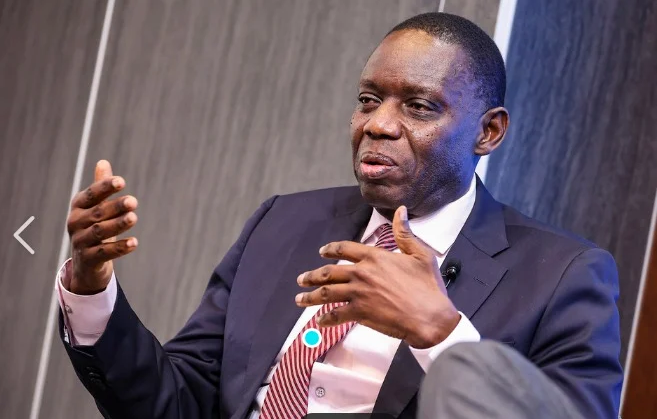
The national dialogue on Uganda's economic future began with a powerful and sobering message from the Governor of the Bank of Uganda, Michael Ating-Ego. He emphasized that macroeconomic stability is the “non-negotiable” foundation upon which the nation’s ambitious ATMS growth strategy must be built. His keynote address set a firm, authoritative tone for the 6th Edition of the Uganda Economic Forum.
The Governor outlined the central bank's unwavering commitment to maintaining price and exchange rate stability while actively supporting Uganda’s transformation. He then issued a direct challenge to the financial sector, urging a fundamental rethink of how growth is funded in alignment with the ATMS (Agro-industrialization, Tourism, Mineral Development, and Science, Technology & Innovation) framework.
“We need to mobilize long-term capital for investment. Let us leave commercial banks to finance working capital,” he asserted. “We need innovative financing for agricultural transformation. It is not business as usual.” This call for patient, long-term capital highlighted the massive investments required to make the ATMS pillars a reality.
The Governor’s address followed an optimistic opening from Moses Kaggwa, Director for Economic Affairs at the Ministry of Finance, who confirmed the economy’s strong 6.5% GDP growth. The forum was also welcomed by Kin Kariisa, Group CEO of Next Media, who promised "exciting" days ahead, with top scholars and industrialists set to dissect the ATMS strategy.
With the stage set, the forum turned its focus to the first pillar of ATMS: Agro-industrialization. The panel discussion featured a dynamic exchange on how to turn this pillar into an engine for growth.
Abbey Seguya of the National Agricultural Research Organisation promised the technological firepower, inviting Ugandans to embrace new, climate-resilient solutions that his institution is developing. Hon. Charles Oleny Ojok from the National Planning Authority hailed the forum itself, stating that "Information sharing will be a key milestone in achieving our tenfold growth strategy" under ATMS.
Bringing a crucial grassroots perspective, Hilda Tumuhe of SEATINI Uganda issued a warning: the ATMS agenda will only succeed if the primary beneficiaries, the farmers, are actively involved in its design and rollout. From the private sector, Dr. Dennis Ngabirano of Sumz Snacks argued that for Vision 2040 to be realized, the ATMS framework must create an enabling environment that pushes Ugandan agro-processors into competitive export markets.
As Day One of the 6th Edition of the Uganda Economic Forum concluded, the message was clear: the ambitious ATMS strategy for a tenfold economic expansion is viable, but it requires an unshakeable foundation of economic stability, a revolution in financing, and a collaborative, all-hands-on-deck approach to turn policy into prosperity.