

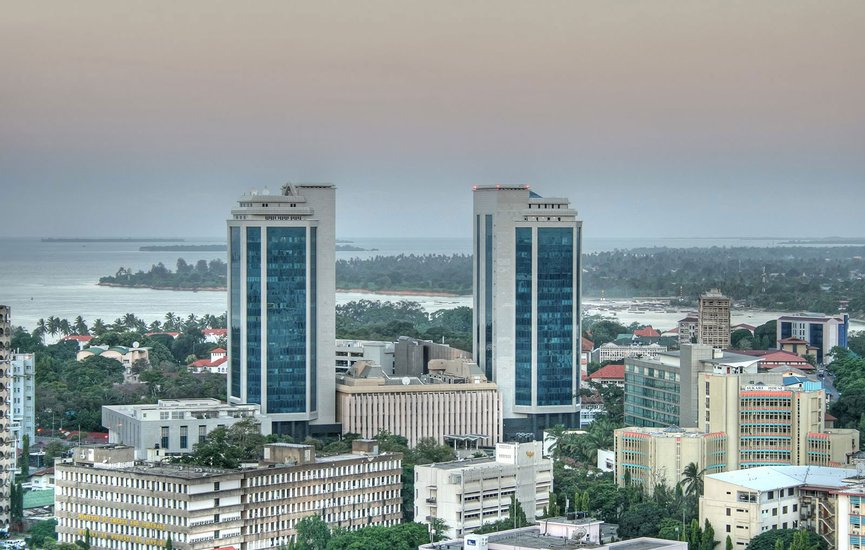
Cairo, Egypt – In 2017, Ahmed Ginah left his village in Egypt’s northern delta and set out for Dar-es-Salaam with little more than a dream. Four years later, that dream became the name of his company.
“When I first arrived in Tanzania at the age of 28, people back home couldn’t understand why I was heading south,” said Ginah, now fondly known as the “Mayor of Egyptians in Dar-es-Salaam.” He explained that many of his friends and family in Egypt still view sub-Saharan Africa through the lens of stereotypes—marked by famine, poverty, and disease.
But upon his arrival, Ginah discovered not despair, but opportunity — and the chance to create something of his own.
“In 2021, I launched my business, Dream [Trading],” he said, naming it after his aspiration to succeed. With just $3,000 in savings, he began by trading aluminium household items, seizing on a growing demand in the local import-export market. Over time, he diversified into the steel industry.
Beyond entrepreneurship, the now 36-year-old has become a supportive figure for fellow North African migrants making the move south — seen by many as a kind of mentor or guiding presence.
Ginah follows a familiar routine each day. His driver, Hamed, first takes him to the Dream Trading warehouses that house his inventory. Later, they head to City Mall in the bustling Kariakoo district, one of Dar es Salaam’s busiest shopping hubs.
There, he’s a fixture at a local Somali café, spending his mornings chatting with other Egyptians and Tanzanians. He often shares a casual breakfast of mandazi — a sweet, deep-fried pastry — or chipsi mayai, a beloved street-side omelette filled with fries, vegetables, and tomato sauce.
Most Egyptians relocating to Tanzania typically have a friend or family member already established there. For those arriving without such connections, Ginah steps in to support them — often helping secure accommodation, occasionally offering them employment at Dream Trading, and even assisting with rent if they join his team. He also familiarizes newcomers with Tanzania’s work culture and provides insights into cities where job opportunities may exist.
“But the most valuable support I offer,” Ginah explained, “is access to a reliable, trusted translator.” While English is spoken in Tanzania’s urban areas, many rural communities primarily speak Swahili. This language gap, he said, can lead to confusion and leave migrants vulnerable to scams or deceit. That’s where Ginah steps in — bridging the divide to help fellow Egyptians find their footing safely.
“I support those who are ready to work,” Ginah said firmly. “But I don’t assist people who expect others—like translators—to do everything for them. In those situations, I make it clear: this country has a lot to offer, but it doesn’t reward laziness or dependence.”
Over the course of eight years, Ginah has achieved significant success. His company now distributes goods across Africa, and he has helped dozens of young men from his hometown in Egypt start new lives in Tanzania. According to Egypt’s ambassador to Tanzania, Sherif Ismail, around 70,000 Arabs now live in the country, including an estimated 1,200 Egyptians as of 2023.
Shifting Migration South
While European nations tighten their borders against migrants from North Africa, many young Egyptians—discouraged by a struggling economy—are turning south instead of west, says Ayman Zohry, a demographer and migration expert at the American University in Cairo.
Migration within the Global South has seen a sharp increase in recent years.
According to official records, the number of Egyptians living in non-Arab African countries rose from 46,000 in 2017 to 54,000 by 2021.
This trend offers a stark contrast to the dangerous crossings that many Egyptians still attempt across the Mediterranean. In 2023, Egyptians made up more than 7 percent of all arrivals in Italy via the Central Mediterranean route, ranking as the fifth most represented nationality, according to a report by the Mixed Migration Centre.
In response, the European Union recently struck a €7.4 billion ($8.7 billion) deal with Egypt—partly aimed at strengthening border controls to curb irregular migration flows to Europe.
According to Zohry, the migration patterns of Egyptian youth are clearly evolving.
“Traditionally, Egyptians looked to the Gulf or Europe for migration,” Zohry said. “But now we’re seeing a growing shift southward—toward select African nations.”
This emerging pattern of “economic migration” involves young Egyptians pursuing business and investment prospects in developing markets. “It’s a trend that has expanded alongside Egypt’s strengthening diplomatic and trade ties with several African countries,” he noted.
Still, Zohry pointed out that this kind of migration is often short-term or cyclical. “In many cases, migrants either return to Egypt after a brief period or move between different African countries based on where new opportunities arise,” he said.
This cyclical pattern of migration is clearly visible every Friday night in Dar-es-Salaam, when a flight departs from Julius Nyerere International Airport en route to Cairo.
During peak periods such as Eid al-Adha and Eid al-Fitr, the departure gates are filled with Egyptian families. Many are returning home with their savings—whether to visit loved ones, invest in building a house, support a relative’s wedding, or help parents realize their dream of performing the Hajj pilgrimage.
Across Africa, Arab and North African diaspora communities are steadily expanding.
South Africa hosts the largest share of Egyptians living on the continent—about 85 percent—followed by countries like Nigeria, Kenya, and Senegal.
Ginah recalls a story from the late 1990s that has since taken on legendary status among Egyptian youth dreaming of success abroad.
“There was a young man who went to South Africa on holiday to visit a friend,” Ginah recounted. “Oddly enough, he got arrested in Cape Town over a visa issue. When he was released, he had no money—only a few aluminium utensils. So, he sold them to afford a ticket back home.”
That incident, he said, revealed a surprising market demand for Egyptian aluminium household products. Word quickly spread, and young people began to realize there was profit to be made. This marked the beginning of a flourishing trade in home goods between Egypt and African markets. Over time, Egyptian business ventures across the continent have broadened to include sectors like manufacturing, agro-processing, and mining.
While North Africans have historically migrated southward, Ginah says the trend accelerated after Egypt’s 2011 uprising and the transformative changes that followed.
“A new wave of migration took off across Africa—not just to South Africa, but to other sub-Saharan countries too,” he explained. “Many were looking for alternatives as political unrest affected traditional destinations like the Gulf and Libya.”
Locally, many migrants say they’ve found a more welcoming and supportive environment for work and business.
Tanzania’s government has taken significant steps to encourage entrepreneurship and attract foreign investment. According to the Lloyds Bank country profile, international investors are offered a range of fiscal and non-fiscal incentives designed to ease entry and foster growth.
“Tanzania is rich in natural resources and offers significant investment opportunities,” said Makame Iddi Makame, Commissioner General and Chief of Staff at the Tanzanian Embassy in Cairo.
He highlighted that the Tanzanian government established the Tanzania Investment Centre to oversee investment activities. Among the incentives available to foreign investors are reduced customs duties—5 percent for priority sectors and 0 percent for key sectors—tax exemptions on mining, agricultural, and industrial inputs, as well as assistance with obtaining residence, work, and business permits. The country also allows the repatriation of capital gains and offers tax and VAT deferrals for loss-making projects for up to five years.
Makame also noted that Tanzania's political stability ensures a high level of investment security, citing the country’s low inflation rate of 4.2 percent and stable exchange rates.
“In comparison to the limited opportunities in Egypt, some African countries may seem less competitive, but they are more receptive to Egyptian expertise in fields such as construction, agriculture, education, and information technology,” explained migration expert Zohry.
Despite these opportunities and a generally more hospitable environment, migration to African countries remains limited compared to the Gulf and Europe. Zohry attributed this to a stigmatized perception that many North Africans hold of the rest of the continent.
However, signs suggest that Africa may gradually become a viable alternative for young people seeking opportunities beyond traditional migration routes.
Business Ventures and Shared Networks
Around 550km (340 miles) southeast of Dar-es-Salaam lies Mayan village, where Mohamed el-Shafie, 34, another Egyptian migrant, established two cashew-processing factories in the Mtwara region in 2018. The business capitalizes on a key crop that contributes 10-15 percent of Tanzania’s foreign exchange earnings.
“Cashew sales are built on trust,” el-Shafie told Al Jazeera. “The process of growing and harvesting cashews is intricate and requires careful handling by farm workers to ensure high-quality nuts. The processing stage is equally important to prepare them for export in optimal condition.”
Tanzania ranks among Africa’s top three producers and exporters of cashew nuts, and is the eighth-largest producer globally.
El-Shafie’s company now serves clients across the Arab world and Turkey, and employs around 400 workers from Egypt, China, and Tanzania, in addition to seasonal laborers hired during the cashew harvest season in October.
His entry into the cashew industry was, by his own admission, serendipitous. El-Shafie, who studied Chinese at Cairo University before continuing his studies in Beijing, explained how his connections led him to Tanzania.
“I had many Vietnamese friends who worked in the cashew industry, and that’s how I first learned about the promising business opportunities in Tanzania. I realized there was a gap in the market for Chinese machinery specialized in cashew processing,” he shared.
In late 2017, with a little help from friends, he established ties with cashew farmers in Tanzania. Armed with a modest investment of 200,000 Egyptian pounds (roughly $11,000 at the time), he set up his business and imported two cashew-processing machines from China. By 2023-2024, Elshafei Investment Limited had made 13 export shipments, valued at around $719,700.
El-Shafie also chose to move his small family to Dar-es-Salaam, so his young children would be closer to him. Today, they live in an area populated by both Arabs and Egyptians, alongside Tanzanians of Yemeni, Omani, and Iranian descent, many of whom had settled there during the Arab rule before the 1964 Zanzibar Revolution.
“We participate in local celebrations and holidays, like Saba Saba Day on July 7, which commemorates the founding of the Tanganyika African National Union (TANU) in 1954—a key milestone in Tanzania’s journey to independence. We also join in the celebration of Swahili Language Day and Eid al-Adha, often sharing communal meals in the cashew farm villages,” he explains.
For Ginah, living in Dar-es-Salaam with his wife and children, Egyptians have woven themselves into the social fabric of their new surroundings.
“We have strong, positive relationships with Tanzanians, and we form friendships through work, mosques, and social clubs,” he shares.
However, living far from home brings its own set of challenges.
“The most painful moments come when someone passes away,” Ginah reflects. “As Egyptians, we’re well-connected across East and West Africa, so losing someone is especially difficult. We immediately come together to arrange for the repatriation of the body, and we offer both emotional and financial support to the family—whether they stay in Tanzania or return to Egypt.”
Yet, Ginah adds, having family nearby alleviates much of the loneliness. "When you have loved ones with you, the feeling of alienation fades," he says. “And thanks to modern technology, we can connect with family and friends daily through phone calls.”
For Ginah, Tanzania has become a place where he feels he was meant to thrive.
“It’s truly become a second home for me, where my children are growing up,” he admits. “As for when I’ll return to Egypt, I’m not sure.”