

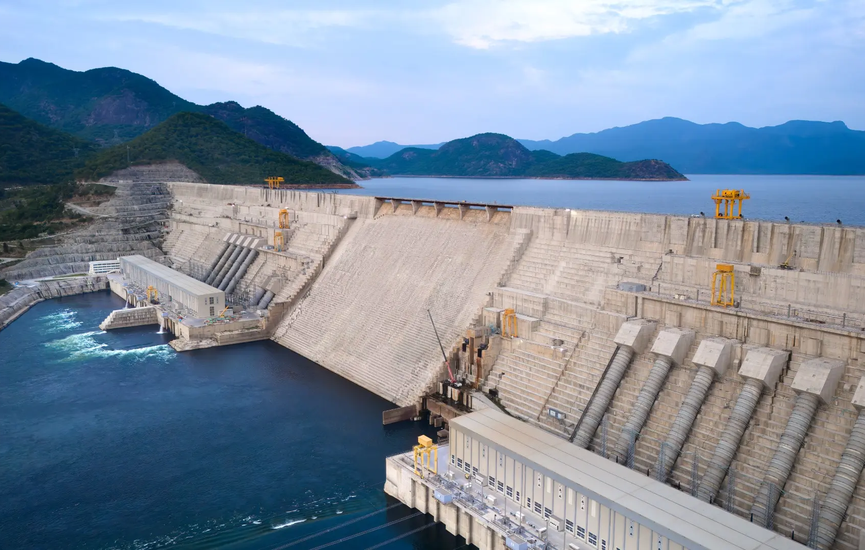
ADDIS ABABA, Ethiopia -Fanuse Adete is among the Ethiopians eagerly awaiting connection to the national electricity grid once the Grand Ethiopian Renaissance Dam (GERD) along the Blue Nile is fully operational, with its inauguration scheduled for Tuesday.
The 38-year-old widowed mother of seven lives in the Menabichu district, just 10 kilometers (6 miles) from the capital, Addis Ababa, and currently relies on kerosene lamps and candles to light her mud-walled home at night.
“Previously, our daily lives relied on kerosene lamps and charcoal, which posed significant challenges. We would transport firewood to the market, selling it to buy kerosene and bread for our children. However, with the completion of the dam, our entire community is now happy,” she said while lighting firewood to prepare traditional Ethiopian coffee.
The Grand Renaissance Dam, expected to generate over 5,000 megawatts, will double Ethiopia’s current electricity output, with some power earmarked for export to neighboring countries. Construction of the dam began in 2011 and has drawn concerns from downstream nations Egypt and Sudan, who fear reduced water levels. Despite forming a joint panel to manage Blue Nile water sharing, tensions persist. Egypt has labeled the project a security risk, citing potential drought impacts downstream.
Ethiopia maintains that the dam will benefit its population of over 100 million as well as neighboring nations and aims to position itself as Africa’s leading electricity exporter. Ethiopian Water Minister Habtamu Itefa stressed that the country has no intention of harming downstream nations.
“So the way forward is: let’s work together for more investment. Let’s join hands to propose more projects that can benefit all of us, wherever they may be. This can be scaled up to Nile Basin countries—to Uganda, to Tanzania, to Rwanda, to D.R.C., to South Sudan, to Kenya, to Ethiopia, to Egypt as well,” Itefa said.
Water experts in Egypt report that the dam has reduced the country’s water intake, prompting short-term measures such as reducing annual consumption and recycling irrigation water. “Egypt was able to overcome this shortage through Egypt’s High Dam, which has a water reserve that is used to replace what was lost due to the GERD. But we can’t always rely on this reserve for water supply,” said Abbas Sharaky, professor of geology and water resources at Cairo University.
Sudanese experts note decreased seasonal flooding during the dam’s filling but caution that uncoordinated water releases could cause sudden flooding or extended dry periods. Itefa, however, stated that during the dry season, downstream water levels were “three to four-fold what they used to get before the dam,” meaning farmers could expand irrigation and benefit from more reliable water.
Yacob Arsano, who teaches hydropolitics in the Nile Basin at Addis Ababa University, emphasized Ethiopia’s careful planning: “Egypt continues to receive the water. Ethiopia continues to send water. So that is the remaining fact, and how to organize shared use of water resources depends on both sides. All upstream and downstream countries need to sit down properly and soberly.”
For Ethiopians, the promise of increased electricity is a welcome sign of development. Amakelech Debalke Gebre-Giorgis, a mother of two in Addis Ababa, expressed her excitement: “We want to see more development, and we want to see more electricity become part of our daily life, and we’re all excited.”