

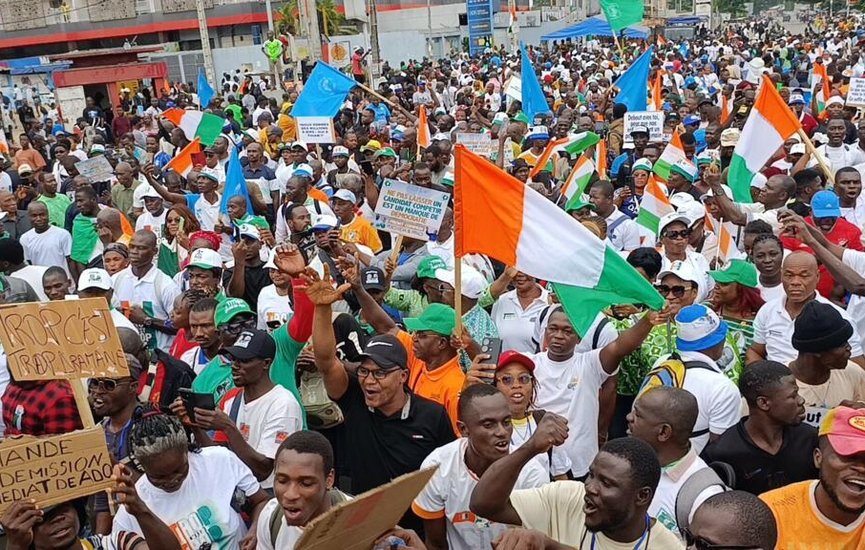
Thousands of Ivorians flooded the streets of Abidjan this weekend in a powerful display of civic engagement, demanding transparency, inclusivity, and justice ahead of the nation’s upcoming presidential election. The protest, held in the populous suburb of Yopougon, was a vivid reflection of growing public frustration over the exclusion of key opposition figures from the October ballot.
Chants of “Enough is enough!” and banners reading “No true democracy without true justice” echoed through the streets as demonstrators rallied behind former President Laurent Gbagbo and former Credit Suisse CEO Tidjane Thiam—two prominent leaders barred from contesting the presidency by the electoral commission earlier this year. Their exclusion has sparked widespread concern over the fairness of the electoral process and the future of democratic governance in Ivory Coast.
The nation, widely regarded as the economic powerhouse of francophone West Africa, now finds itself at a political inflection point. President Alassane Ouattara, 83, recently announced his intention to seek a fourth term—an unprecedented move made possible by a 2016 constitutional amendment that removed presidential term limits. His decision has reignited debates over executive overreach and the erosion of democratic norms in the region.
“We don’t want a fourth term, and we want the electoral roll revised,” said activist Sagesse Divine, who joined the march. “We want all candidates’ names included, and we want to go to the elections in peace. That’s all we want.”
Tidjane Thiam, now president of the Democratic Party of Ivory Coast, had secured his party’s nomination in an uncontested primary. However, his candidacy was rejected on the grounds that he held French citizenship at the time of his declaration, despite having since renounced it. Ivorian law prohibits dual nationals from running for the presidency—a clause that critics argue is being selectively enforced.
The exclusion of Thiam and Gbagbo, both seen as formidable challengers to Ouattara, has cast a shadow over the electoral process. It has also reignited memories of past political unrest. Ivory Coast’s elections have historically been marred by violence, most notably during Ouattara’s bid for a third term, which led to deadly clashes across the country.
The broader West African region is grappling with a wave of constitutional manipulations and political instability. Leaders in several countries have extended their rule by altering term limits, while military coups—often justified by claims of corruption and electoral fraud—have fractured regional unity. ECOWAS, the regional bloc once seen as a stabilizing force, now faces internal divisions over how to respond to these democratic backslides.
Ouattara has defended his candidacy by citing the country’s pressing challenges, including economic volatility, security threats, and monetary uncertainty. He argues that his experience is essential to navigate these turbulent times.
Yet for many Ivorians, the call is not just for leadership—it’s for legitimacy. The protests in Abidjan reflect a yearning for a political system that respects the rule of law, embraces pluralism, and honors the will of the people. As the October election approaches, the world watches closely, hoping that Ivory Coast will choose the path of democratic renewal over authoritarian entrenchment.