

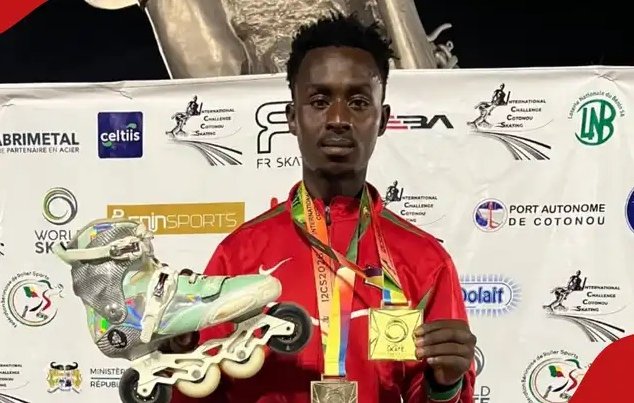
Kenyan roller skater Kelvin Kiarie is drawing widespread attention after winning both gold and silver medals at an international competition in Benin while reportedly representing his country without official government support.
Kiarie’s achievement has sparked mixed reactions across social media and sports circles, with many praising his resilience and determination, while others question the level of institutional backing for emerging athletes in Kenya.
Competing alone, without a full national delegation or visible state facilitation, Kiarie managed to outperform top contenders to secure podium finishes in multiple categories. His performance has been described as both inspiring and concerning, highlighting the gap between talent and support systems in African sports development.
Photos circulating online show the athlete proudly displaying his medals alongside his skating gear, symbols of a journey many believe was driven by personal sacrifice rather than structured national support.
The story has reignited debate around funding and recognition for non-mainstream sports, especially those outside football and athletics, which traditionally receive the bulk of attention in many African countries.
While some observers have called for immediate government intervention and support for athletes like Kiarie, others argue that his success demonstrates the power of individual determination despite systemic challenges.
As discussions continue, Kiarie’s victory stands as both a personal triumph and a broader statement on the realities faced by many talented athletes across the continent.