

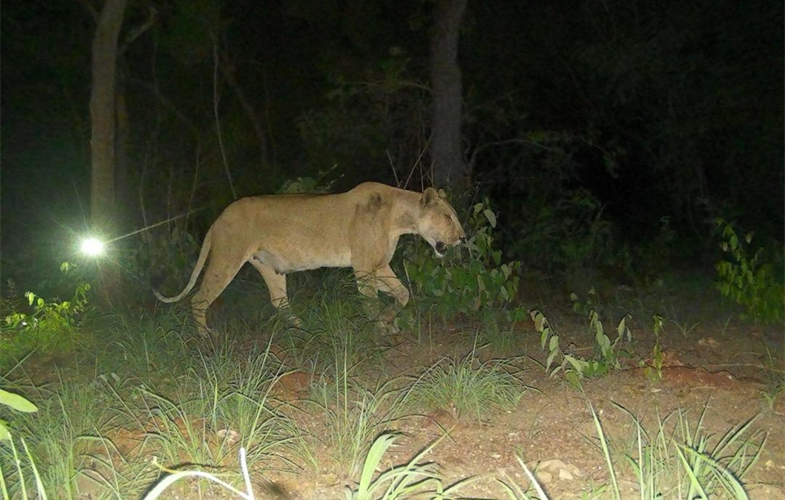
A rare photograph of a lactating lioness, captured by a remote camera in Bamingui-Bangoran National Park, Central African Republic, is renewing hope for the survival and recovery of Africa’s increasingly threatened lion populations.
The lioness the first female sighted in the park in over six years was spotted as part of a wildlife monitoring effort by the Wildlife Conservation Society (WCS). Conservationists say her lactating condition strongly suggests that cubs are present in the area, a positive indication that breeding activity is underway in one of the continent’s most vulnerable lion habitats.
“For years we have recorded only male lions, raising concerns about whether breeding females even remained in these parks,” said Armand Luh Mfone, WCS’s Director of Programs in the Central African Republic. “The discovery of this lioness, especially one that appears to be nursing cubs, demonstrates that with strong protection efforts, this landscape still has the potential to support a thriving lion population.”
Bamingui-Bangoran National Park lies within a larger wilderness complex covering over 113,000 square kilometers. It includes other critical wildlife areas such as the Manovo-Gounda-St Floris National Park and several faunal reserves. While the ecosystem remains largely intact and sparsely populated by humans, it is under constant threat from ivory poaching, bushmeat hunting, illegal resource extraction, and regional instability.
Despite these pressures, the recent sighting offers a rare and much-needed sign of hope.
Across the continent, lion populations have declined drastically. Once numbering around 200,000 a century ago, Africa’s lion population is now estimated to be between 20,000 and 23,000. A 2025 report by LionAid estimates only 13,014 lions remain in eastern and southern Africa, with just 342 in the western and central regions where lions are genetically distinct and especially endangered.
“There is no effective wildlife department, and levels of commercial poaching are extremely high,” LionAid said in its report. “There is little to no interest by citizens or government to conserve wildlife” in many parts of Central Africa.
The International Union for Conservation of Nature (IUCN) currently lists lions as “Vulnerable,” with recovery scores as low as 23 to 33 percent, labeling their status in many areas as “largely depleted.”
Still, there are places where conservation efforts are beginning to show results. In East Africa, for instance, lion numbers in Kenya have been climbing steadily. The Kenya Wildlife Service reports a 25 percent increase over the past decade, from 2,000 in 2010 to 2,589 in 2020. At the Lewa-Borana landscape, the lion population rose from 59 in 2023 to 77 in 2024, with 30 new births recorded — gains attributed to long-term habitat protection and anti-poaching initiatives.
The Sheldrick Wildlife Trust, in collaboration with KWS, reported in August that their mobile vet units have treated over 800 lions in the wild to date. “Working closely with conservation partners and local communities, we provide a rapid ground and aerial response to mitigate human-lion conflict and give big cats safe passage back into parks and protected areas,” the Trust said in a statement.
Scientific studies also support the idea that recovery is possible. A 2024 study published in Conservation Science and Practice found that lion fertility and cub survival rates were significantly higher in well-protected areas and had improved notably in recent years.
“Our results demonstrate that increasing protection is likely to improve lion demography over large areas,” the authors concluded.
Beyond ecological significance, lions remain a cornerstone of Africa’s tourism economy. “Lions are the top draw for wildlife tourism in Africa, yet they’re now extinct in over half the continent’s countries,” said Peter Knights, CEO and co-founder of Wild Africa. “Protecting lions means protecting jobs, ecosystems, and a key part of Africa’s identity.”
According to the LionAid 2025 report, lions are now extinct in 26 of Africa’s 48 countries. Only five regions across the continent host more than 1,000 lions including Kenya and Tanzania’s Serengeti-Mara ecosystem and South Africa’s Kruger National Park.
Back in Central Africa, the image of a nursing lioness stands as a symbol of resilience a sign that even in the face of hardship, nature can bounce back. Conservationists say that with the right support, Bamingui-Bangoran and its neighboring parks could one day host as many as 500 lions.
But that future depends on consistent protection, funding, and political will. As Luke Hunter, Executive Director of WCS’s Big Cats Program, put it: “The habitat remains largely intact, with low human densities, offering an extraordinary chance for recovery. We just have to act now.”