

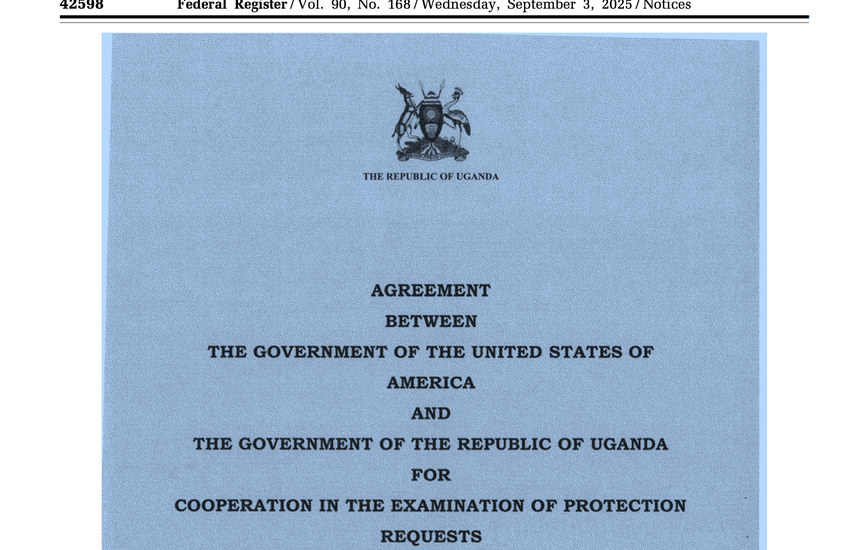
Kampala | The full text of the US-Uganda migration cooperation agreement, officially titled Agreement Between the Government of the United States of America and the Government of the Republic of Uganda for Cooperation in the Examination of Protection Requests, was published this week in the US Federal Register. Signed on July 29, 2025, the agreement outlines the terms under which asylum seekers denied protection in the United States could be transferred to Uganda, a move that has sparked significant debate and scrutiny.
Under the agreement, the US has the discretion to propose the transfer of third-country nationals who have been denied asylum but cannot safely return to their home countries. Uganda, however, retains the "complete discretion" to accept or reject these transfers on a case-by-case basis, ensuring that the process respects both countries’ legal and humanitarian obligations.
Key Provisions of the Agreement
The five-article agreement lays out several important conditions:
- Transfer Discretion: The US can propose transfers, but Uganda holds the final decision on whether to accept or decline each request (Article 1).
- Compliance with International Laws: Both parties agree to abide by international conventions, including the 1951 Refugee Convention and the 1967 Protocol, along with the UN Convention Against Torture. Uganda is obligated to consider asylum claims based on its own laws (Article 2).
- Non-Refoulement Commitment: Uganda is prohibited from returning any transferred individual until their asylum claim is resolved, and a national procedure for determining status will be established. The transfer of unaccompanied minors is explicitly banned (Article 3).
- Operational Procedures: Both governments will develop operating procedures for implementing the agreement and settle disputes through diplomatic channels (Article 4).
- Termination and Suspension: The agreement can be suspended or terminated by either party with written notice. Its implementation is contingent on available funds and technical capacity (Article 5).
Uganda’s Position
Uganda’s Ministry of Foreign Affairs has emphasized that this agreement is temporary and conditional. Permanent Secretary Vincent Bagiire Waiswa clarified that Uganda will not accept all individuals proposed for transfer, particularly those with criminal records or unaccompanied minors. Uganda has also expressed a preference for accepting transfers of individuals from African countries.
“This is a temporary arrangement with conditions,” said Waiswa. “We will not accept everyone the US seeks to transfer.”
The deal adds to Uganda's ongoing challenge of managing a large refugee population, already hosting over 1.5 million refugees from countries like South Sudan and the Democratic Republic of Congo. Critics argue that this agreement could further strain Uganda’s overstretched systems, while supporters assert that it strengthens Uganda’s strategic partnership with the United States, showcasing its role as a regional stabilizer.
Diplomatic Context
The agreement was signed by US Ambassador to Uganda William W. Popp and his Ugandan counterpart in late July. It marks a significant step in repairing US-Uganda diplomatic and trade ties, particularly following Uganda’s suspension from the African Growth and Opportunity Act (AGOA) in 2023. Recent talks between Ugandan President Yoweri Museveni and US Secretary of State Marco Rubio have focused on migration and trade, with the migration agreement seen as a key element in revitalizing the bilateral relationship.
With the full text now available, the agreement is set to undergo domestic scrutiny and parliamentary debate. Humanitarian organizations and refugee agencies are also expected to closely monitor its implementation, ensuring that it aligns with both countries’ international obligations and the best interests of vulnerable asylum seekers.
Looking Ahead
As Uganda continues to grapple with its role as one of the largest refugee-hosting nations in the world, the publication of this agreement sets the stage for future discussions on its impact. Whether the deal will alleviate or exacerbate Uganda’s refugee burden remains a point of contention, but the terms are now clear, providing transparency in an issue that has long been subject to speculation and political debate.